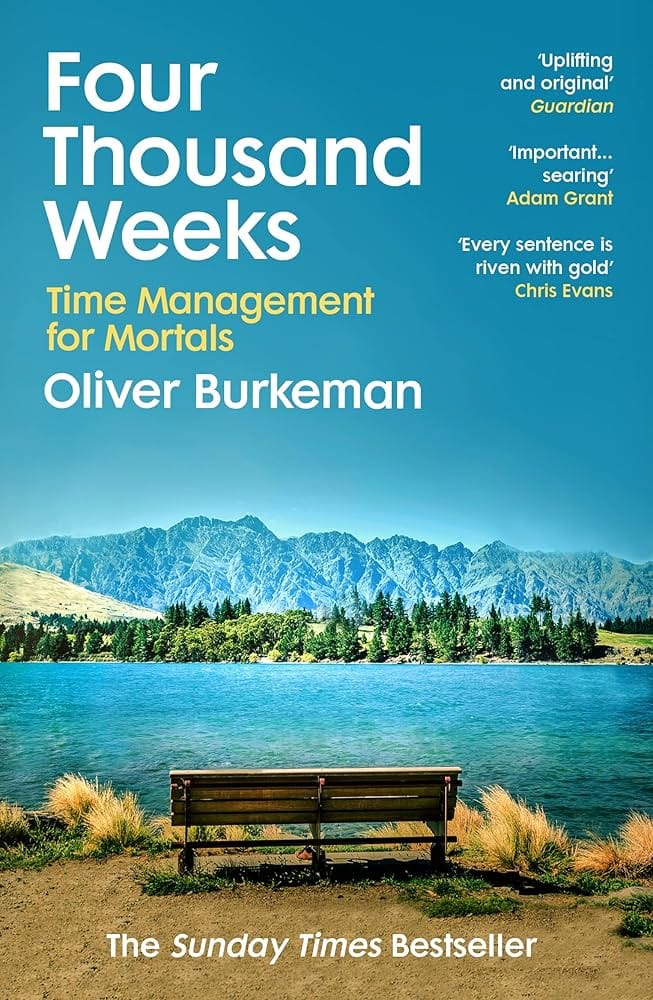
Four Thousand Weeks by Oliver Burkeman
I read this book recently and thought I’d write down my impressions of it. It’s a time management book that explores “some ways of thinking about time that do justice... to the outrageous brevity and shimmering possibilities of our four thousand weeks”.
Burkeman’s departure point is: time management as we know it has failed, and we need something better. It has failed not because the usual time management techniques don’t work, but rather because they do work, quite well, and we’re led to think we can get more and more done in the limited amount of time, when instead we should be aiming to get less done, choosing wisely what we spend our time on.
Nobody in the history of humanity has ever achieved ‘work–life balance’, whatever that might be, and you certainly won’t get there by copying the ‘six things successful people do before 7 a.m’. The day will never arrive when you finally have everything under control – when the flood of emails has been contained; when your to-do lists have stopped getting longer; when you’re meeting all your obligations at work and in your home life; when nobody’s angry with you for missing a deadline or dropping the ball; and when the fully optimised person you’ve become can turn, at long last, to the things life is really supposed to be about. Let’s start by admitting defeat: none of this is ever going to happen.
But you know what? That’s excellent news.
What follows is more a list of loosely organized useful ideas I gathered from the book than any kind of systematic review.
Our relationship with time
The book uses the customary romanticization of medieval European peasant life (almost a rite of passage in the genre) to trace our journey away from a day or a life dictated by the rhythms of nature and community, to one dictated by the clock. In doing so, Burkeman claims, we’ve stopped thinking of time as something interwoven with our tasks, and instead as something that we can use or control; use well by doing more, use poorly by not doing enough. This leads to the efficiency trap:
‘Work expands so as to fill the time available for its completion,’ the English humorist and historian C. Northcote Parkinson wrote in 1955, coining what became known as Parkinson’s law. But it’s not merely a joke, and it doesn’t apply only to work. It applies to everything that needs doing. In fact, it’s the definition of ‘what needs doing’ that expands to fill the time available.
As an example, the very act of clearing your inbox leads you to having more emails; if you think you should be able to do everything, you’ll never say no to things: after all, infinity plus one is still just infinity.
Burkeman then takes up Heidegger’s idea of a human being as a finite amount of time: to have been born at a specific point in time, and to die at a specific point (and to know that one is to die eventually). The central challenge is whether we confront this fact.
The real measure of any time management technique is whether or not it helps you neglect the right things.
Three somewhat-practical principles that stood out to me:
- pay yourself first: do the most important things first, and deal with the consequences of not doing the other things later;
- limit your work in progress: pick maybe 3 tasks you’re working on at a time; this forces you to not pretend you have infinite time and can do everything;
- resist the allure of middling priorities: figure out what you really want to do, and then decide you’re not going to do the things you somewhat want to do: these take away precious time and attention (the 5/25 rule).
Distraction and procrastination
On why we procrastinate:
Six hundred miles away in Paris, and two decades before Franz met Felice, the French philosopher Henri Bergson tunnelled to the heart of Kafka’s problem in his book Time and Free Will. We invariably prefer indecision over committing ourselves to a single path, Bergson wrote, because ‘the future, which we dispose of to our liking, appears to us at the same time under a multitude of forms, equally attractive and equally possible’. In other words, it’s easy for me to fantasise about, say, a life spent achieving stellar professional success, while also excelling as a parent and partner, while also dedicating myself to training for marathons or lengthy meditation retreats or volunteering in my community – because so long as I’m only fantasising, I get to imagine all of them unfolding simultaneously and flawlessly. As soon as I start trying to live any of those lives, though, I’ll be forced to make trade-offs – to put less time than I’d like into one of those domains, so as to make space for another – and to accept that nothing I do will go perfectly anyway, with the result that my actual life will inevitably prove disappointing by comparison with the fantasy. ‘The idea of the future, pregnant with an infinity of possibilities, is thus more fruitful than the future itself,’ Bergson wrote, ‘and this is why we find more charm in hope than in possession, in dreams than in reality.’
Incidentally, the quoted passage illustrates a recurring theme in the book: Burkeman quotes people more eloquent than himself, and then spends twice as many words explaining their (already quite clear) ideas. By no means a bad thing! (after all, a book that mostly quotes less eloquent people sounds worse).
Why do we find it so hard to resist the distractions of our smartphones and social media? Yes, there are a lot of people being paid a lot of money to keep us glued to these, but the real reason, Burkeman hypothesizes, is that we want to be distracted, because we’d rather not spend time thinking about the things that matter to us, because we’re trying to flee something uncomfortable and painful. Instead we must lean into the pain, not in a masochistic way (though I’m sure Burkeman wouldn’t object if that’s what you’re into), but by accepting that discomfort is a part of life.
Attention, on the other hand, just is life: your experience of being alive consists of nothing other than the sum of everything to which you pay attention. At the end of your life, looking back, whatever compelled your attention from moment to moment is simply what your life will have been. So when you pay attention to something you don’t especially value, it’s not an exaggeration to say that you’re paying with your life.
All of this is liberally interspersed with the usual smattering of parables involving medieval monks, Buddhist monks, Silicon Valley monks, and Warren Buffett.
Ends and means
Comparing different philosophies of child-rearing, Burkeman reflects on his obsession with the “developmental milestones” of his newborn son’s life:
The writer Adam Gopnik calls the trap into which I had fallen the ‘causal catastrophe’, which he defines as the belief ‘that the proof of the rightness or wrongness of some way of bringing up children is the kind of adults it produces’. That idea sounds reasonable enough – how else would you judge rightness or wrongness? – until you realise that its effect is to sap childhood of any intrinsic value, by treating it as nothing but a training ground for adulthood.
Lamenting the similar use of leisure not as an end in itself (as Aristotle saw it) but as a means to achieve more productivity:
Ironically, the union leaders and labour reformers who campaigned for more time off, eventually securing the eight-hour workday and the two-day weekend, helped entrench this instrumental attitude towards leisure, according to which it could be justified only on the grounds of something other than pure enjoyment. They argued that workers would use any additional free time they might be given to improve themselves, through education and cultural pursuits – that they’d use it, in other words, for more than just relaxing. But there is something heartbreaking about the nineteenth-century Massachusetts textile workers who told one survey researcher what they actually longed to do with more free time: to ‘look around to see what is going on’. They yearned for true leisure, not a different kind of productivity. They wanted what the maverick Marxist Paul Lafargue would later call, in the title of his best-known pamphlet, The Right To Be Lazy.
Some useful ideas for cultivating rest and leisure:
- establishing rules for rest: Burkeman uses the example of the Sabbath to show that rest is a serious business. If you truly want to achieve it, you need to establish rules for it, and then stick to them. A social/communal framework that encourages (or even enforces) them makes rest easier to achieve.
- cultivating hobbies: not in the sense of a ‘side-hustle’ or something you hope to eventually turn into an income stream, but simply things you enjoy doing because they are fun.
A taste for problems
Another symptom of our obsessive need to control time is how impatient we get in traffic, or with things we think we should be doing (such as reading) but can never quite stick to for more than a few minutes without being bored. One way to embrace patience is to develop a taste for having problems: life is just a series of engagements with various problems (which Burkeman defines as something that demands that you address yourself to it), and the goal shouldn’t be to eradicate them (or not have them at all) but to figure out what you want to address yourself to. The mathematics people have intuited this understanding in some sense: their ‘problems’ aren’t things to run away from or get rid of, but important questions to be addressed.
Another such problem is that of other people: other people’s schedules, and the constraints induced by them, aren’t obstacles to overcome, but rather something of value, because there is value in doing things with other people, at the same time, whether it’s marching together, singing together, or engaging in political activity together.
In the grand scheme of things, our lives are quite insignificant; this, paradoxically, can help us imbue our everyday actions with more meaning, since they’re freed from the pressure of having to be impressive accomplishments.
In the final chapter, Burkeman returns to the fantasy that once we control time, then we can start setting our lives in order.
It’s tempting to imagine that ending or at least easing the struggle with time might also make you happy, most or all of the time. But I’ve no reason to believe that’s true. Our finite lives are filled with all the painful problems of finitude, from overfilled inboxes to death, and confronting them doesn’t stop them from feeling like problems – or not exactly, anyway. The peace of mind on offer here is of a higher order: it lies in the recognition that being unable to escape from the problems of finitude is not, in itself, a problem. The human disease is often painful, but as the Zen teacher Charlotte Joko Beck puts it, it’s only unbearable for as long as you’re under the impression that there might be a cure. Accept the inevitability of the affliction, and freedom ensues: you can get on with living at last.
This chapter offers us five questions to think about (and to carry with us into our lives):
- Where in your life or your work are you currently pursuing comfort, when what’s called for is a little discomfort?
- Are you holding yourself to, and judging yourself by, standards of productivity or performance that are impossible to meet?
- In what ways have you yet to accept the fact that you are who you are, not the person you think you ought to be?
- In which areas of life are you still holding back until you feel like you know what you’re doing?
- How would you spend your days differently if you didn’t care so much about seeing your actions reach fruition?
He ends with ten practical tips in addition to some of the broader strategies outlined in the book. I’m not listing them here; you can read them in this pamphlet (incidentally, made by someone who wants to “help companies capitalise on their #1 asset, their people”).
What I took from it
Ultimately, most of the main ideas in this book (as Burkeman repeatedly points out) are not that original: we have a a finite amount of time, we cannot get anything meaningful done unless we recognize this and focus on what’s important to us, our finitude (and mortality) aren’t conditions to be lamented or railed against, but useful constraints that we can use to direct the course of our lives; embracing boredom, cultivating patience, living in the moment; treating our lives (and those of others) as ends rather than means. However, what it offers is all of these ideas in one place, packaged together with a unifying harmony that serves to re-emphasize the basic point: using the finitude of our time to guide us towards what is important, rather than trying to fit everything in it and then feeling disappointed when that inevitably fails.
It is less a list of immediately practicable tips (outside of that appendix), and more an attempt to recenter the conversation around the importance of bringing intentionality into how we spend our time. It does feel like a bunch of blog posts bundled together into a book: many of the same points get repeated across chapters, and I suspect you could read the various chapters and sections in any order without affecting comprehensibility.
Ultimately, like all self-help books, I will only really know how helpful this is once I try to implement the ideas (and especially think about the questions above) and see the results.